Four patients. One open room.
Know who goes first.
The waiting room is full and nobody hands you a textbook. 364 pages of numbered illustrations, comparison charts, mnemonics and memory tricks turn triage, trauma, tox and everything in between into pictures you can read at a glance. Every chapter is mapped to the BCEN CEN content outline, so you always know which part of the exam you're studying.
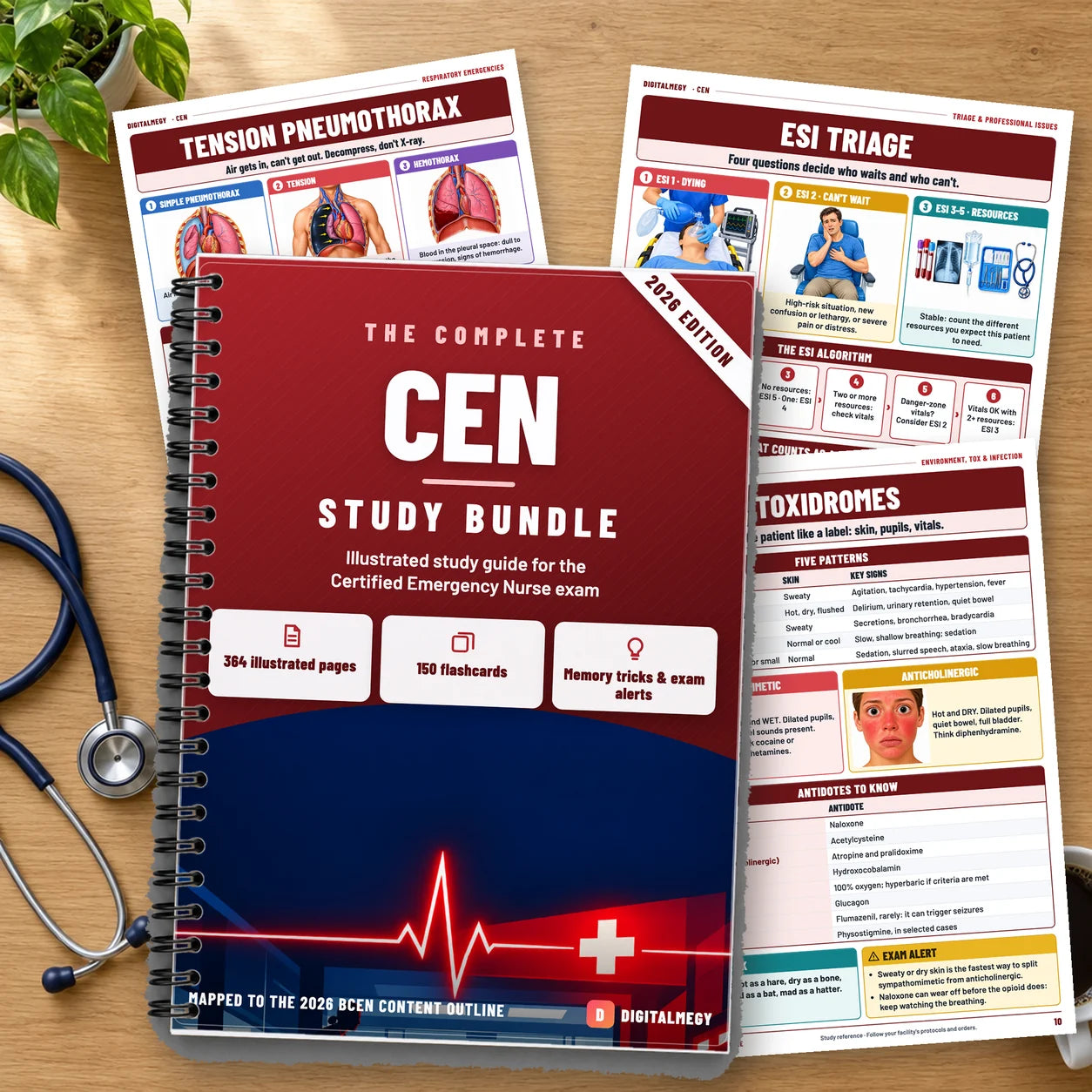
Not notes. A visual system.
Every spread uses the same five tools, so your brain always knows where to look, even after a 12-hour shift.
Whatever shift you're on, you start today.
Make sense of the chaos
Triage, toxidromes and trauma drawn so you understand why the patient looks the way they do, not just what to chart. Use them in the department now, and they're your CEN review when you decide to sit the exam.
Ten minutes is enough
Every topic fits on a short page you can read on a break or the morning after a shift. Plus the 3 badge cards for your reel: ESI triage and danger-zone vitals, toxidromes and antidotes, and GCS with BE-FAST stroke signs.
Walk in certified
BCEN recommends two years of emergency experience but doesn't require it, and you need a current, unrestricted RN license. Check the current eligibility rules on the BCEN site before you book.
Spot it. Compare it. Know what comes first.
In the ED the question is rarely just what it is. It's what you do first. So every topic in the bundle follows the same path: it starts from what you see at the bedside, puts the look-alikes side by side, and ends on the priorities. The CEN outline has 11 content areas, and 33 of the 150 scored questions come from three you may not see every shift: obstetrics and gynecology (with GU), mental health, and head, eye, ear, nose and throat.
Spot it
Every clinical topic starts from what you actually see: the triage picture, the vitals, the ECG, the skin and the pupils. Drawn so you know what stands out first.
Compare it
Previa vs abruption, ischemic vs hemorrhagic stroke, tension pneumothorax vs tamponade. The comparison charts put the look-alikes side by side so you can tell them apart in seconds.
Know what comes first
Every topic ends on a short priority sequence: what you do first and what comes next. It's how the CEN asks its questions, and it's how you already think in the department.
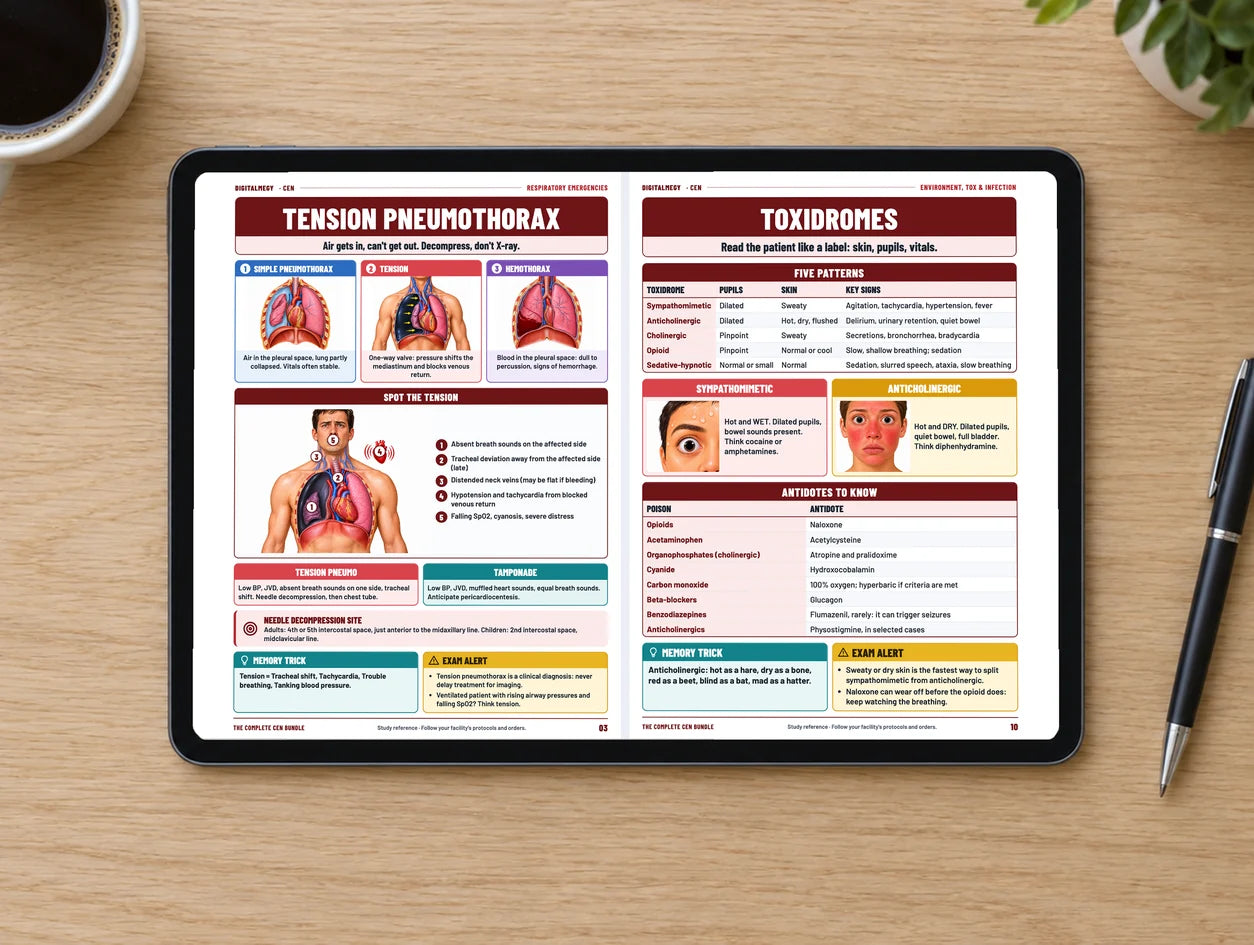
Treat the tension before the X-ray.
Falling SpO2 and a blood pressure that won't hold. Here simple pneumothorax, tension pneumothorax and hemothorax sit side by side, so you see what's different and which one can't wait.
- Simple pneumothorax, tension and hemothorax drawn next to each other
- The signs of tension numbered on the chest, plus the look-alike: tamponade
- Needle decompression sites for adults and for children
- Asthma and COPD, pneumonia, PE, inhalation injury, ARDS, croup and airway obstruction: from the signs to the priority
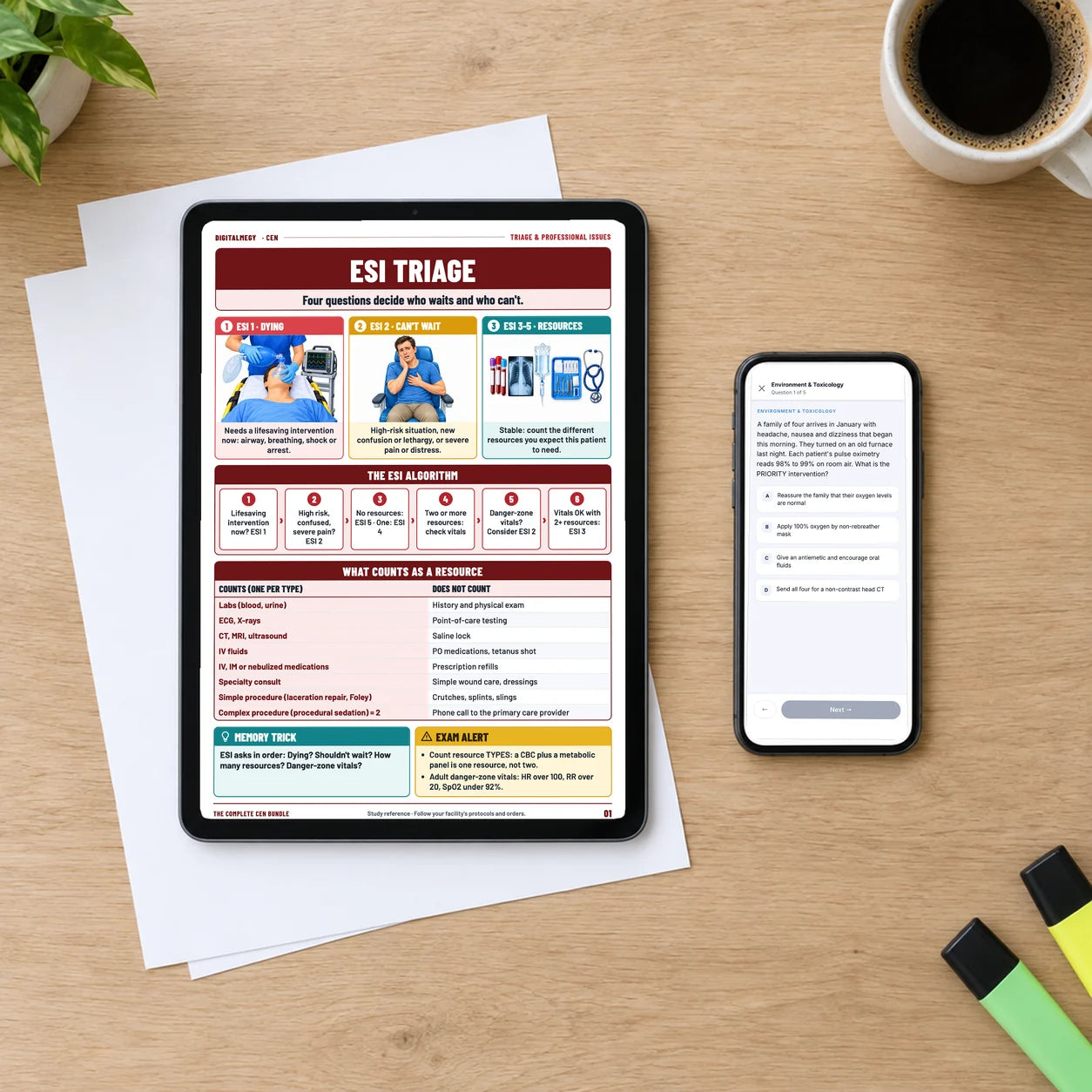
Four questions decide who waits.
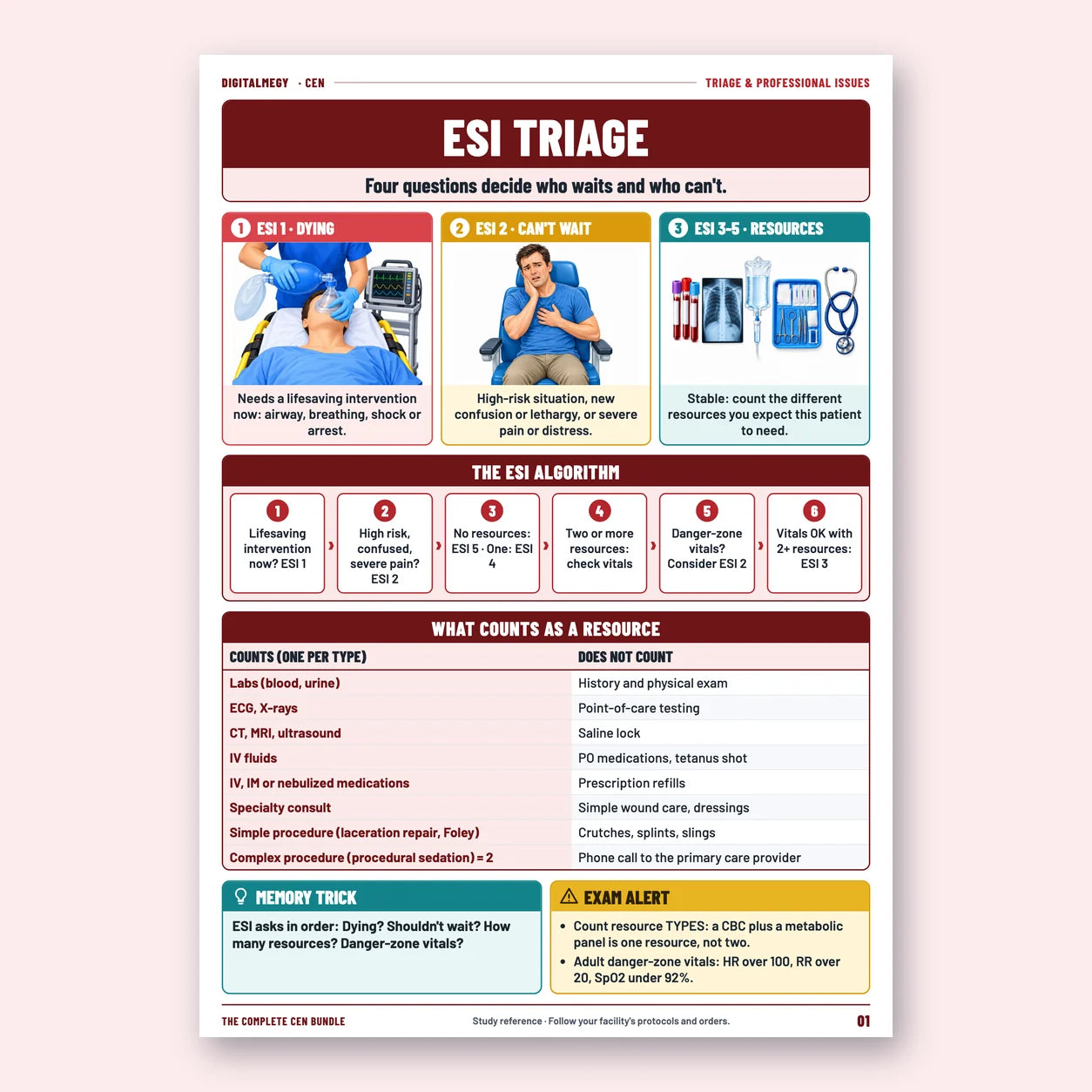
Four patients arrive within minutes of each other and one room is open. Here the ESI is drawn as a short sequence of questions, so you go from the first look to the right level without second-guessing.
- ESI 1, ESI 2 and ESI 3 to 5 drawn side by side: dying, can't wait, resources
- The ESI algorithm step by step, and what does and doesn't count as a resource
- Adult danger-zone vitals: HR over 100, RR over 20, SpO2 under 92%
- Mass casualty, throughput, consent, EMTALA, forensic evidence, abuse and workplace violence
Read the patient like a label.
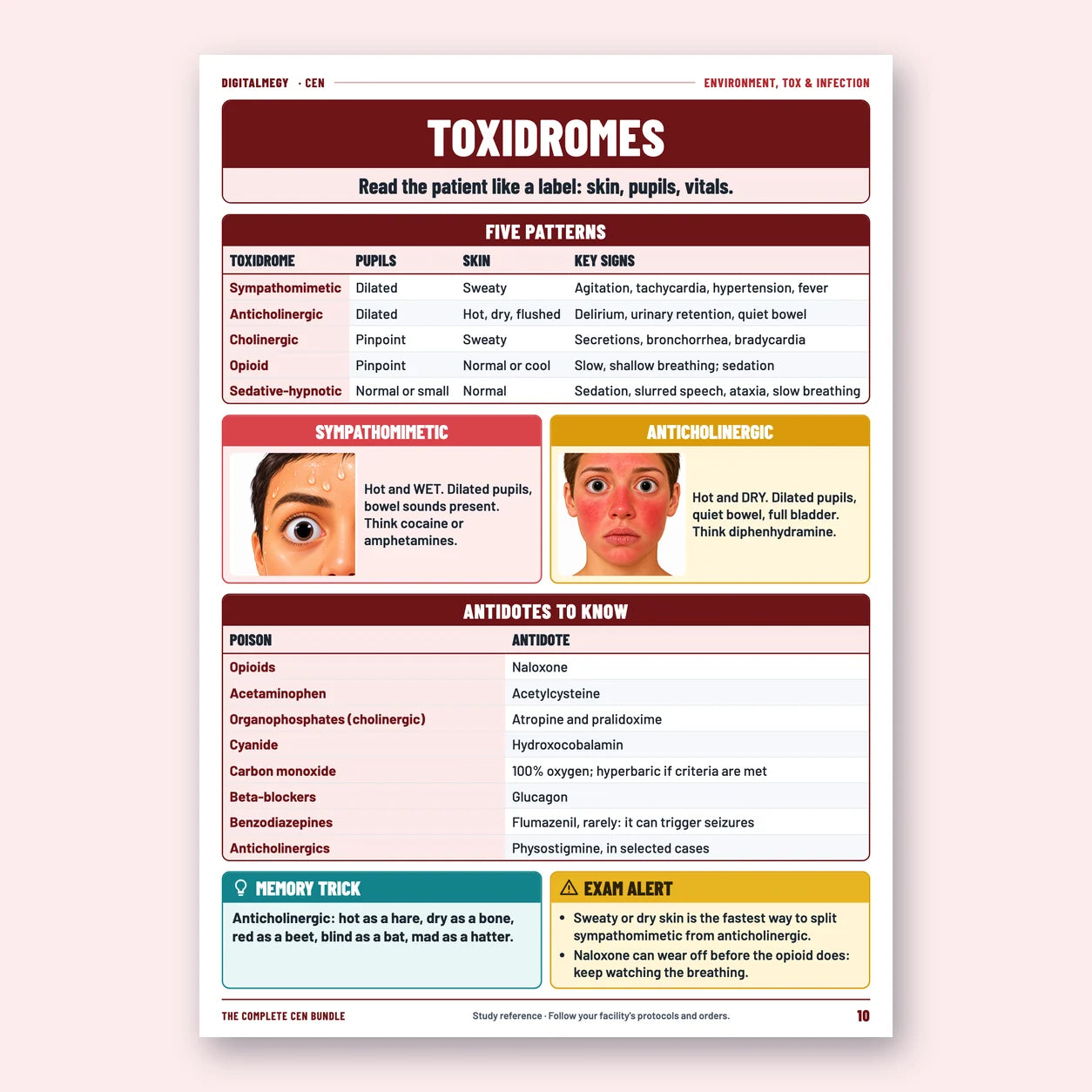
An overdose with no history. Here the toxidromes are read from the pupils, the skin and the vitals, and the look-alikes sit next to each other, so you can name the pattern before the labs come back.
- Five toxidromes in one chart: sympathomimetic, anticholinergic, cholinergic, opioid and sedative-hypnotic
- Hot and wet vs hot and dry: how to split the two fastest
- Antidotes to know, from naloxone and acetylcysteine to hydroxocobalamin
- Burns, heat and cold, submersion, carbon monoxide and cyanide, and isolation precautions
ECG in 10 minutes. Then find the artery.
A diaphoretic patient with jaw discomfort and a normal-looking chest pain history. Here ACS and the 12-lead are drawn as a map of the heart, so you go from the strip to the wall to the artery, and from there to what you do first.
- STEMI, NSTEMI and unstable angina drawn side by side
- Find the territory: which leads look at which wall, and which artery is usually behind it
- Inferior and RV MI vs anterior MI: why you look right before anyone gives a nitrate
- Dysrhythmias, arrest, heart failure, dissection, tamponade, cardiogenic and obstructive shock: from the signs to the priority
Last known well starts the clock.
Stroke symptoms can start before the patient reaches you. Here the types of stroke, BE-FAST and the stroke alert are drawn step by step, so you know what to check first and what can't wait.
- Ischemic stroke, hemorrhagic stroke and TIA drawn side by side
- BE-FAST at triage, letter by letter, and the stroke alert sequence in the ED
- Increased ICP, head and spinal cord injury, seizures, meningitis and neurogenic shock: from the signs to the priority
- "Glucose before CT: hypoglycemia can look exactly like a stroke." Flagged as an exam alert, together with how to count the time when the patient woke up with symptoms
The last weeks before the CEN, on 20 pages.
The distinctions you'll want to reread, condensed into cram sheets you can go through between shifts.
- The key comparisons and memory tricks from across the chapters, in one place
- Short enough to reread the night before
- Mapped to the CEN content outline, so you can see which areas you've covered

Your review book explains it. These pages show it.
The drawing, the color and the layout are the mnemonic: you remember the page, so you remember the answer.
- Mapped to the CEN content outline effective July 2026
- Built on the official 2026 CEN content outline
- Updated every year; ebook buyers get the new edition free
Inside the bundle.
The whole outline, in one bundle.
Full table of contents
On your iPad, on your phone, or printed at home.
Instant download, hyperlinked index
Works in GoodNotes, Notability and any PDF app. Full color, 8.5 × 11, prints cleanly at home. Free update every year.
150 flashcards and 3 badge cards.
Triage, toxidromes, antidotes and every body system in the outline: the drawing on one side, the answer on the other. Print them, ring them, or swipe them in GoodNotes on your break. The badge cards fit your reel: ESI triage and danger-zone vitals, toxidromes and antidotes, and GCS with BE-FAST stroke signs.
- Printable PDF, 4 per page
- Digital version with hyperlinked index
- Badge cards as a printable PDF, ready to laminate
Get 10 real pages, free.
ESI triage, acute coronary syndrome, tension pneumothorax, stroke and TIA, GI bleeding, third-trimester bleeding, suicide risk, anaphylaxis, eye emergencies and toxidromes: ten real pages from the bundle. Study them after your next shift and decide with the pages in your hands.
How it stacks up.
| Feature | This bundle | Review book | Review course | Q-bank app |
|---|---|---|---|---|
| Every topic built around a drawing | ✓ | Some figures | Mostly video & slides | ✗ |
| Every topic from the presentation to the priority | ✓ | Varies | Varies | Question by question |
| Mnemonics and memory tricks in every chapter | ✓ | Varies | Varies | Varies |
| Practice questions | Pair with one | Varies | ✓ | ✓ (timed) |
| iPad + print at home | ✓ | Print or ebook | Screen | Screen |
| Badge cards for your shift | ✓ | ✗ | Rarely | ✗ |
| Free ebook updates | ✓ | New edition $ | Varies | Varies |
| Price | $39.99 | Varies | Varies (BCEN's: $250) | Varies |
Studying after your next shift, not next month.
Checkout
Secure checkout, no account to create. Everything is included.
Open it anywhere
Your download link arrives by email. Open it in GoodNotes, Notability or any PDF app, or print the pages you need.
Start with the cram sheets
Print the cram sheets and the badge cards, keep the rest on your iPad or phone, and study from page one tonight.
Everything, in one bundle.
- 364 illustrated pages, 13 chapters, mapped to the CEN content outline
- Every topic built the same way: spot it, compare it, know what comes first
- 44 pages of cardiovascular emergencies, the 12-lead included
- 36 pages of respiratory emergencies, tension pneumothorax to ARDS
- 150 printable & digital flashcards
- 3 badge cards for your shift
- CEN cram sheets
- Free yearly update for the ebook
- Print any page at home, full color
The questions nurses ask before buying
Will this be enough to pass the CEN?
It covers the content the CEN draws on: all 11 areas of the content outline, from triage and professional issues to trauma, with the distinctions worth drilling flagged as exam alerts. But the CEN is 175 questions (150 scored, 25 unscored pretest) in 3 hours, so you also need practice answering under time. Pair the bundle with a question bank or BCEN's own review course: the pages help you remember, the questions teach you to apply.
Is this a subscription?
Yes, and here is exactly how it works. Today you pay $39.99 for the bundle and your first month of the DIGITALMEGY Club (monthly study-material updates, new resources and member-only discounts). After that, $39.99 every 30 days until you cancel. There is no minimum term. You can cancel any time, at least 24 hours before your next charge, at support@digitalmegy.com or (801) 946-7564.
Does it include practice questions?
No, and we'd rather tell you up front. The bundle is the content: illustrated, organized and easy to review between shifts. For timed practice, pair it with a question bank app or the review resources on the BCEN site. The two work together: pages to remember, questions to apply.
I already have a review book or a course. Do I need this?
Keep them. A course explains, a book goes deep, a question bank tests you. This is the part you reread: every topic on a page you can picture during the exam.
Do I need ED experience to sit the exam?
You need a current, unrestricted RN license in the US, its territories, Canada or Australia. BCEN recommends two years of emergency experience but doesn't require it. The current rules on the BCEN site are the ones that count: check them before you book your date.
How many questions do I need to get right?
BCEN's current FAQ says 99 of the 150 scored questions, which is 66%. The 25 pretest questions don't count, and you won't know which ones they are. Passing standards can be updated, so confirm the latest on the BCEN site.
I work three 12s. When am I supposed to study?
That's who we built it for. Every topic fits on a short page you can get through in about ten minutes, on a break or the morning after a shift. The badge cards keep triage, toxidromes and stroke signs in front of you, and the cram sheets are made for the last weeks before your date.
It's been years since nursing school. Can I keep up?
Yes, that's who the drawings are for. Every page starts from the picture and the findings you already see in the department, then explains what's behind them without assuming you remember every class.
I've been in the ED for years. Is this too basic?
The pages start from what you already see in the department, then go to the distinctions the CEN tests: the look-alike presentations, the early sign versus the late one, what comes first versus what comes next. Experienced nurses usually skim the familiar pages and spend their time on the exam alerts and the areas they don't see every shift, like obstetrics, eyes and ENT, and mental health.
My CEN is in a few weeks. Is it too late?
No. Start with the cram sheets, use the exam alerts in each chapter to find your weak spots, then switch to practice questions on those areas. Keep the badge cards close for the quick reviews.
I'm retaking the CEN. Will this help?
Yes. Reopen the chapters for the areas that felt weakest, drill practice questions on them, and finish with the cram sheets the week before. BCEN requires a 90-day wait before a retest, and the current retake rules are on the BCEN site.
Will it help with the TCRN or CPEN?
The bundle is written for the CEN. The trauma chapter and the emergency physiology overlap with other emergency certifications, but each one has its own focus and test plan. If you're taking one of those, check its test plan on the BCEN site and use the chapters that match.
Will my hospital pay for the exam or a differential?
It depends on your hospital. Some pay an hourly differential, some a bonus, some reimburse the exam fee, and some do none of these. Ask your manager or HR before you book the exam: they may cover part of the cost, and some hospitals reimburse study materials too. Your order confirmation works as a receipt.
Can I use it in the department?
The badge cards and the quick-reference pages are made for your locker and your reel. But it's a study guide, not a clinical manual: always follow the provider's orders, your department's protocols and your pharmacy.
Is it up to date?
Yes. This is the 2026 edition, mapped to the CEN content outline effective July 2026. We update it every year, and ebook buyers get the new edition free.
Which apps does the ebook work with?
Any PDF app: GoodNotes, Notability, Apple Books, Adobe, Xodo. The index is hyperlinked so you can jump between chapters. You can also print any page.
Can I print it?
Yes. The PDF is 8.5 × 11, full color, and prints cleanly at home or at any print shop. Most nurses print the cram sheets and the badge cards, and keep the rest on their iPad or phone.
What if it isn't for me?
Email us within 30 days and we refund you. No questions, no forms.
Ready to walk into the CEN knowing who goes first?
364 illustrated pages, 13 chapters, 150 flashcards, 3 badge cards. Instant download. 30-day guarantee. Includes the DIGITALMEGY Club ($39.99 every 30 days, cancel anytime).
$39.99 · instant access