Two lives, one strip.
Know the decel that matters.
At 3 a.m. the baseline shifts, the decels line up with every contraction, and nobody hands you a textbook. 368 pages of numbered illustrations, comparison charts, mnemonics and memory tricks turn the strip, the complications and the emergencies into pictures you can read at a glance. Every chapter is mapped to the C-EFM and RNC-OB outlines, with NICHD terms throughout, so you always know which part of each exam you're studying.
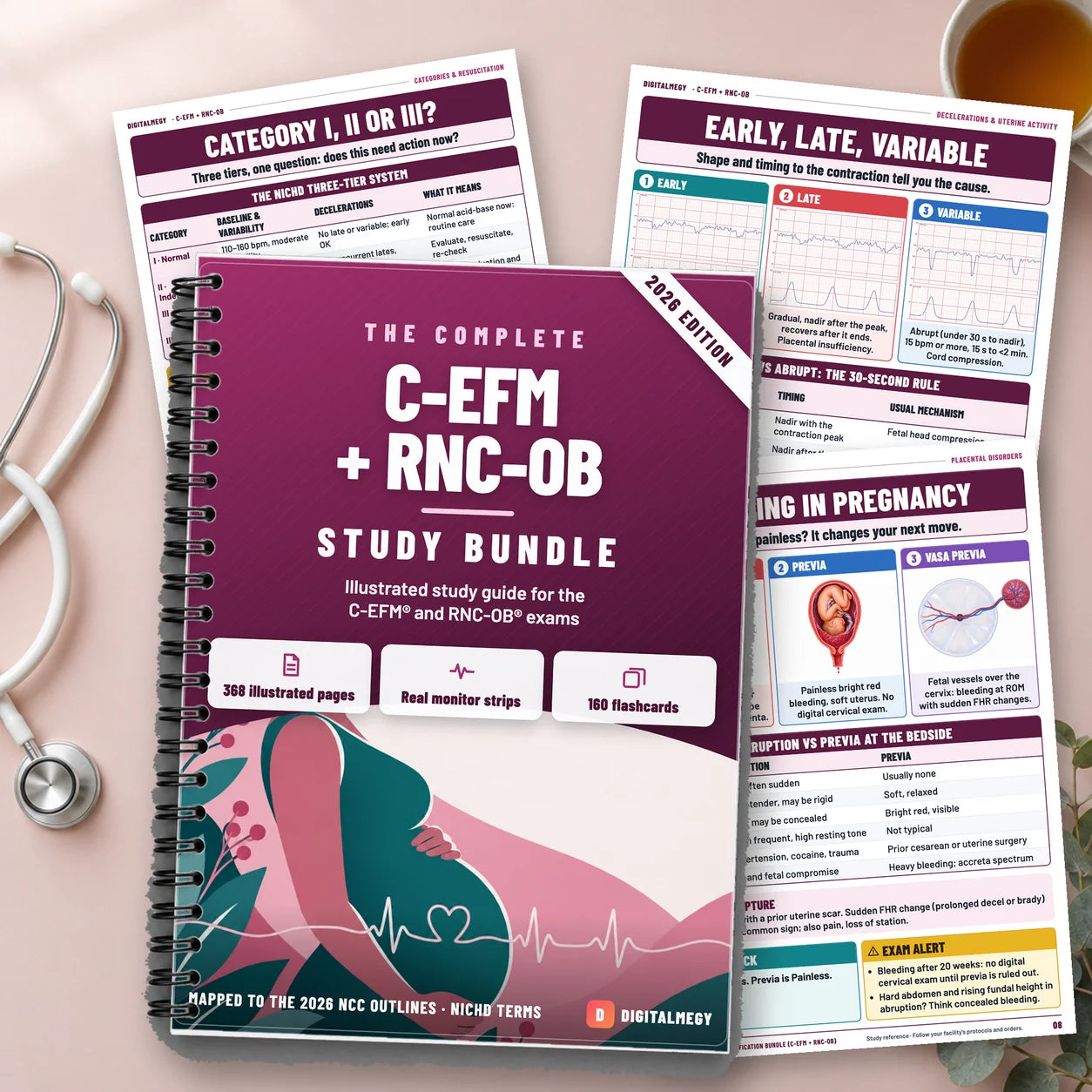
Not notes. A visual system.
Every spread uses the same five tools, so your brain always knows where to look, even after a 12-hour shift.
Whatever shift you're on, you start today.
Make sense of the strip
Baselines, variability and decels drawn so you understand why they move, not just what to chart. Use them on the unit now, and they're your exam review the day you decide to sit.
Ten minutes is enough
Every topic fits on a short page you can read on a break or the morning after a shift. Plus the 3 badge cards for your reel: NICHD definitions, the three categories, and a postpartum hemorrhage & magnesium card.
Two exams, one set of pages
The C-EFM and the RNC-OB are separate exams with separate registrations, but the pages cover both: 172 pages for each, plus cram sheets for both. Check NCC for each exam's eligibility.
See the strip. Name the pattern. Know what comes first.
70% of the C-EFM is pattern recognition, causes and interventions, and on the RNC-OB the biggest area is labor and birth (36%). Both exams are built on a patient, a set of findings and a decision. So every topic in the bundle follows the path you already use at the bedside: it starts from what you see on the strip or in the patient, gets to the pattern or the problem, and ends on what comes first. Fetal physiology, monitoring equipment, fetal assessment methods and professional issues each get their own chapter too, in NICHD terms.
See the strip
Every topic starts from what you actually see: the baseline, the variability, the decels, the contraction channel and the patient. Drawn so you know which findings move together and which one to look at first.
Name the pattern
From the findings to the pattern: early, late or variable; Category I, II or III; abruption or previa. The comparison charts put the look-alikes side by side so you can tell them apart in seconds.
Know what comes first
Every topic ends on what you do next and what comes first. It's how both exams ask their questions, and it's how you already think on the unit.
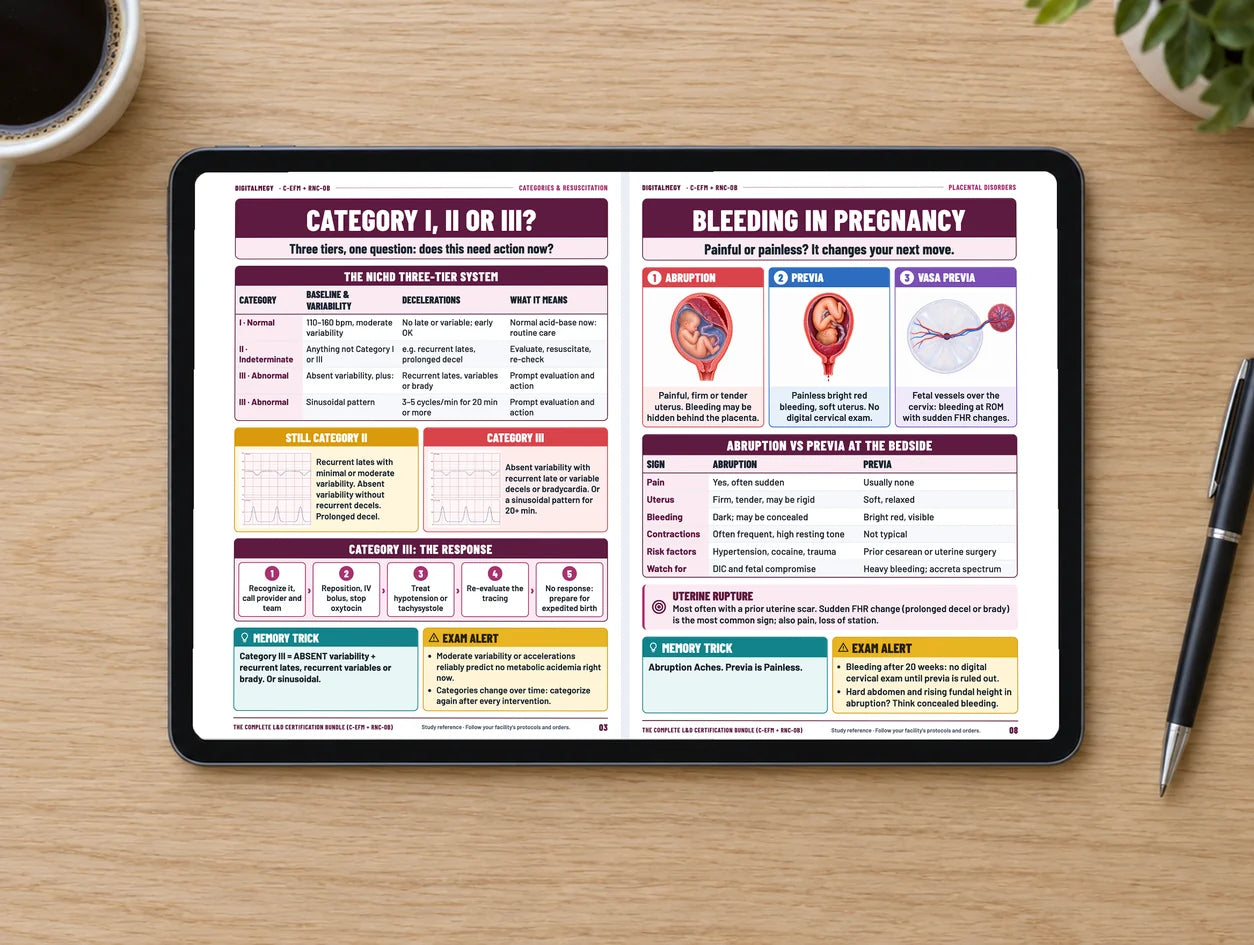
Every category on one chart.
Moderate variability, minimal variability, recurrent lates: on the strip they can look alike until you read the whole pattern. Here each category is one row of the same chart, so you see what makes it I, II or III and what to do about it.
- The NICHD three-tier system in one table: baseline and variability, decelerations, what it means
- Still Category II vs Category III, drawn side by side
- Category III: the response, step by step, and what to do when the tracing doesn't respond
- Fetal dysrhythmias and complications on the strip, from the pattern to the priority
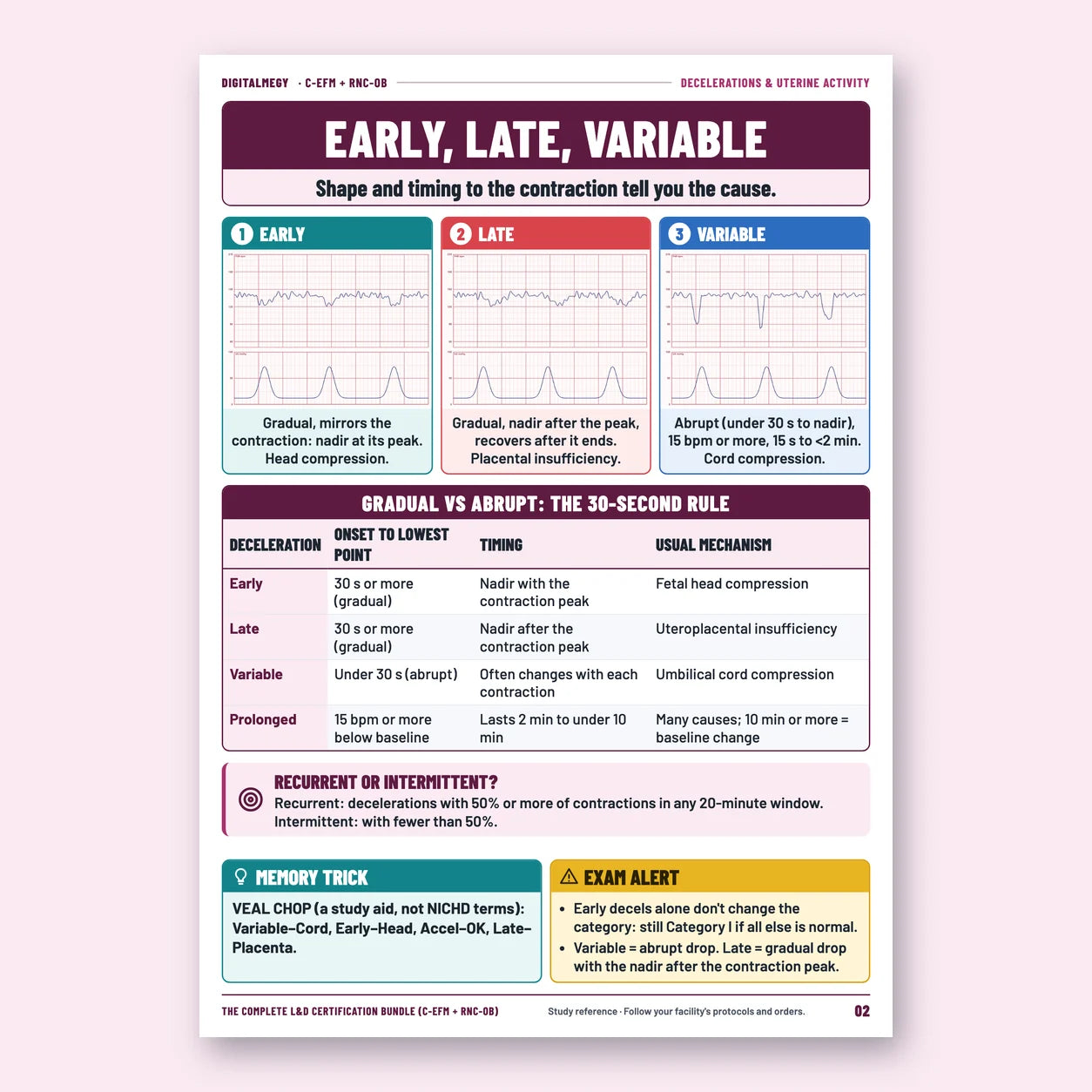
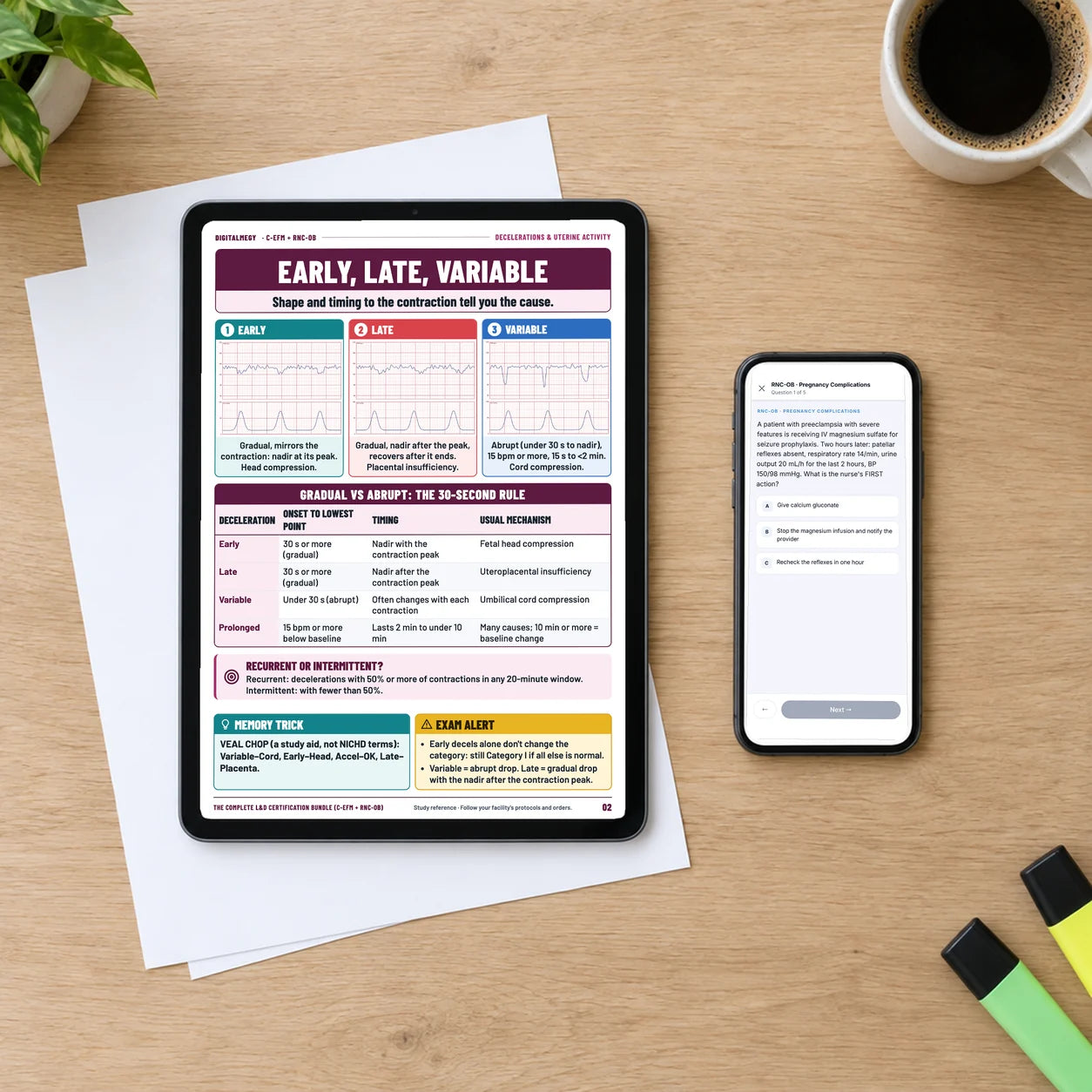
Read the decel against the contraction.
Shape and timing to the contraction tell you the cause. Here early, late and variable decels are drawn on the same strip layout with the contraction channel underneath, so you see the nadir and the timing at a glance.
- Early, late and variable side by side, with the likely cause behind each one
- The 30-second rule: gradual vs abrupt, and where prolonged fits
- Recurrent or intermittent: 50% or more of contractions in a 20-minute window
- Tachysystole and sinusoidal patterns, from the strip to the priority
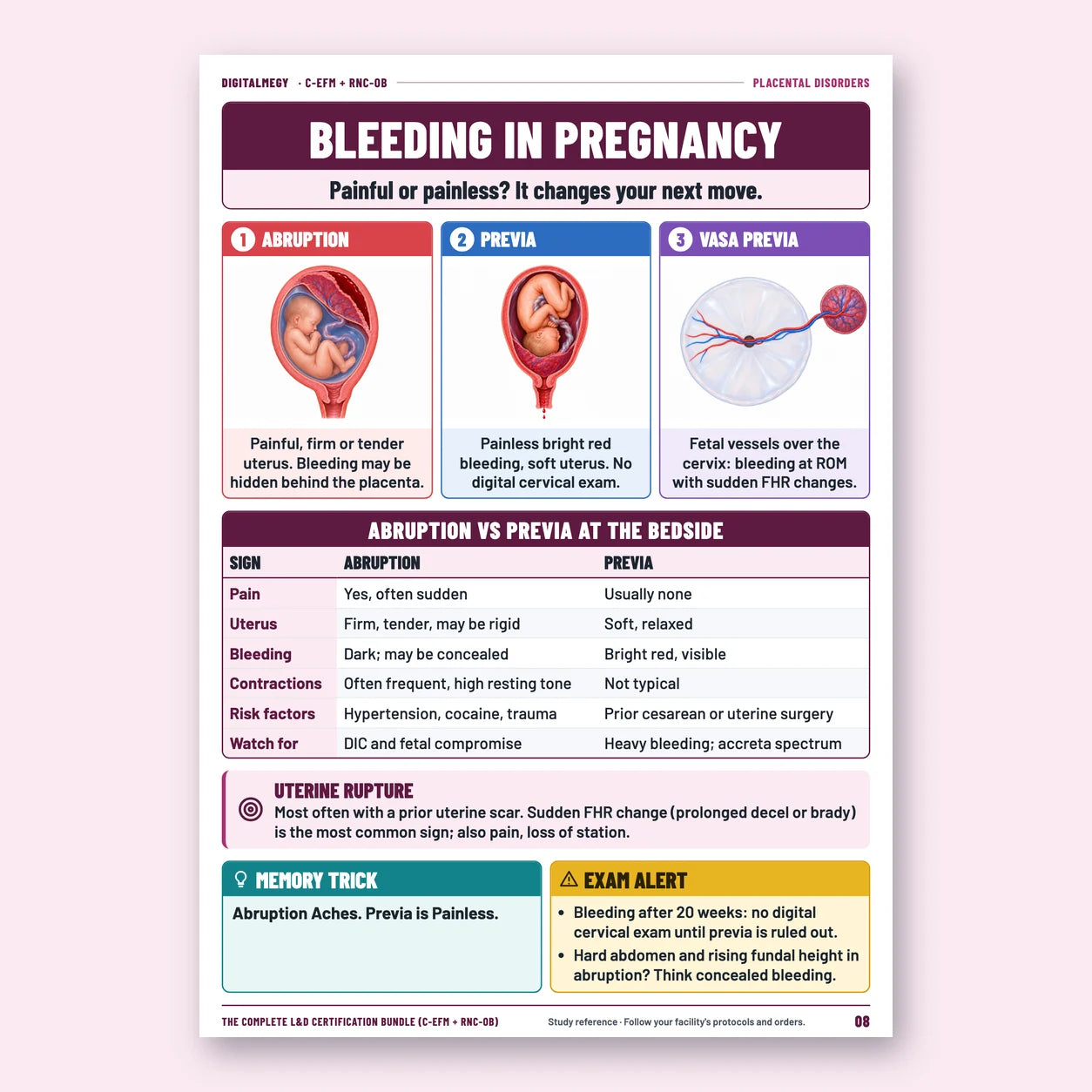
Painful or painless? Your next move changes.
Bleeding after 20 weeks and the clock is running. Here abruption, previa and vasa previa are drawn side by side, with the signs that tell them apart and the priority for each one.
- Abruption, previa and vasa previa drawn in cross-section
- Abruption vs previa at the bedside: pain, uterus, bleeding, risk factors, what to watch for
- Preterm labor, multiples, mental health and substance use, in the same format
- Uterine rupture and the sign that most often comes first: a sudden FHR change
Know the severe features. Guard the magnesium.
Preeclampsia is a head-to-toe list, and the magnesium checks are where questions hide. Here the severe features are drawn on the body and the magnesium checks are laid out in a table, so you know what to look at and why.
- Severe features drawn head to toe, with a numbered legend
- Diagnosis vs severe-range blood pressure, side by side
- Magnesium sulfate: what to check, the warning sign and why it matters, with the antidote at the bedside
- Diabetes, cardiac, hematologic and infections in the same format
Every second has a job.
Emergencies don't give you time to flip pages. Here shoulder dystocia, cord prolapse, rupture and amniotic fluid embolism are drawn step by step, so the sequence is already in your head when it counts.
- Shoulder dystocia drawn in cross-section, with the maneuvers in order
- HELPERR: the sequence in one table, and what never to do
- Operative and cesarean birth, TOLAC, cord prolapse, uterine rupture and amniotic fluid embolism
- After the birth: what to check in the newborn and the mother, and what to document
- "HELPERR: Help, Evaluate, Legs, Pressure, Enter, Remove, Roll." Flagged as a memory aid: the order can vary
The last weeks before the exams, on 24 pages.
The patterns, categories, complications and emergencies the exams ask about most, condensed into cram sheets you can reread between shifts: 12 pages for the C-EFM and 12 for the RNC-OB.
- Every deceleration and every category on one page
- The NICHD definitions, preeclampsia and magnesium, and the 4 Ts at a glance
- Labor, emergencies and postpartum care on one page each
- A study plan built around your shifts: what to review each week, and when to switch to practice questions
- The exam-area map: every chapter linked to the C-EFM and RNC-OB outlines

Your review book explains it. These pages show it.
The drawing, the color and the layout are the mnemonic: you remember the page, so you remember the answer.
- Mapped to the C-EFM and RNC-OB outlines, with NICHD terms throughout
- Built on the official 2026 NCC outlines
- Updated every year; ebook buyers get the new edition free
Inside the bundle.
Both outlines, in one bundle.
Full table of contents
On your iPad, on your phone, or printed at home.
Instant download, hyperlinked index
Works in GoodNotes, Notability and any PDF app. Full color, 8.5 × 11, prints cleanly at home. Free update every year.
160 flashcards and 3 badge cards.
Strip patterns, categories, complications, emergencies and postpartum care: the drawing on one side, the answer on the other. Print them, ring them, or swipe them in GoodNotes on your break. The badge cards fit your reel: NICHD definitions, the three categories, and a postpartum hemorrhage & magnesium card.
- Printable PDF, 4 per page
- Digital version with hyperlinked index
- Badge cards as a printable PDF, ready to laminate
Get 10 real pages, free.
Baseline and variability, early vs late vs variable, the three categories, intrauterine resuscitation, signal ambiguity, NST, BPP and cord gases, preeclampsia and magnesium, bleeding in pregnancy, shoulder dystocia and postpartum hemorrhage. Study them after your next shift and decide with the pages in your hands.
How it stacks up.
| Feature | This bundle | Review book | Review course | Q-bank app |
|---|---|---|---|---|
| Every topic built around a drawing | ✓ | Some figures | Mostly video & slides | ✗ |
| Every topic from the strip to the priority | ✓ | Varies | Varies | Question by question |
| Mnemonics and memory tricks in every chapter | ✓ | Varies | Varies | Varies |
| Practice questions | Pair with one | ✓ | ✓ | ✓ (timed) |
| iPad + print at home | ✓ | Print or ebook | Screen | Screen |
| Badge cards for your shift | ✓ | ✗ | Rarely | ✗ |
| Free ebook updates | ✓ | New edition $ | Varies | With subscription |
| Price | $39.99 | Varies | Varies | Varies |
Studying after your next shift, not next month.
Checkout
Secure checkout, no account to create. Everything included.
Open it anywhere
Your download link arrives by email. Open it in GoodNotes, Notability or any PDF app, or print the pages you need.
Start with the cram sheets
Print the cram sheets and the badge cards, keep the rest on your iPad or phone, and study from page one tonight.
Both exams, one bundle.
- 368 illustrated pages, 12 chapters, mapped to the C-EFM and RNC-OB outlines
- Every topic built the same way: see the strip, name the pattern, know what comes first
- 104 pages on reading the strip: baseline, variability, decelerations and categories
- 172 pages for the RNC-OB: complications, labor and birth, emergencies and postpartum
- 160 printable & digital flashcards
- 3 badge cards for your shift
- C-EFM and RNC-OB cram sheets, 24 pages
- Free yearly update for the ebook
- Print any page at home, full color
The questions nurses ask before buying
Will this be enough to pass the C-EFM and RNC-OB?
It covers the content both exams draw on: pattern recognition, causes and interventions, fetal physiology, monitoring equipment, fetal assessment methods, pregnancy complications, labor and birth, and recovery, postpartum and newborn care, with the distinctions the exams keep asking flagged as exam alerts. But the C-EFM is 125 questions in 2 hours and the RNC-OB is 175 in 3 hours, most of them clinical scenarios, so you also need practice answering under time. Pair the bundle with a question bank: the pages help you remember, the questions teach you to apply.
Is this a subscription?
Yes, and here is exactly how it works. Today you pay $39.99 for the bundle and your first month of the DIGITALMEGY Club (monthly study-material updates, new resources and member-only discounts). After that, $39.99 every 30 days until you cancel. No minimum term. Cancel any time, at least 24 hours before your next charge, at support@digitalmegy.com or (801) 946-7564.
Does it include practice questions?
No, and we'd rather tell you up front. The bundle is the content: illustrated, organized and easy to review between shifts. For timed practice, pair it with a question bank app or the practice resources listed on the NCC site. The two work together: pages to remember, questions to apply.
I already have a review book or a course. Do I need this?
Keep them. A course explains, a book goes deep, a question bank tests you. This is the part you reread: every topic on a page you can picture during the exam.
Do I have to take both exams? Which one first?
No, they are separate exams with separate registrations, and the pages work for either one or both. The C-EFM is open to licensed clinicians and doesn't require experience (it's recommended). The RNC-OB needs a US or Canadian RN license, 24 months of experience in the specialty with at least 2,000 hours, and recent work in the specialty. The current rules on the NCC site are the ones that count: check them before you book your date.
I work three 12s. When am I supposed to study?
That's who we built it for. Every topic fits on a short page you can get through in about ten minutes, on a break or the morning after a shift. The badge cards keep the definitions, the categories and the hemorrhage checks in front of you, and the plan in the cram sheets is built around a shift schedule, not a school semester.
It's been years since nursing school. Can I keep up?
Yes, that's who the drawings are for. Every page starts from the picture and the findings you already see on the unit, then explains the physiology behind them without assuming you remember your obstetrics class.
I read strips every shift. Is this too basic?
The pages start from what you already see on the unit, then go to the distinctions the exams test: the look-alike decels, minimal vs absent variability, the Category II tracing that still needs action now. Experienced nurses usually skim the familiar pages and spend their time on the exam alerts and the areas they don't see every shift.
My exam is in a few weeks. Is it too late?
No. Start with the cram sheets and the exam-area map, use the exam alerts in each chapter to find your weak spots, and follow the study plan: it tells you what to review each week and when to switch to practice questions.
I'm retaking an exam. Will this help?
Yes. Start from your score report, then reopen the chapters behind your weakest area, drill practice questions on it, and finish with the cram sheets the week before. NCC sets a waiting period and a yearly limit on retakes (45 days, and no more than twice a year for the same exam at the time of writing), so check the NCC site for the current rules.
Will it help with other NCC certifications?
The bundle is written for the C-EFM and the RNC-OB. Other certifications have their own outlines, so part of the physiology may overlap but the focus is different. If you're taking another one, check its outline on the NCC site and use the chapters that match.
Will my hospital pay for the exam or a differential?
It depends on your hospital. Some reimburse the exam fee, some pay an hourly differential or a bonus, and some do none of these. Ask your manager or HR before you book the exam: they may cover part of the cost, and some hospitals reimburse study materials too. Your order confirmation works as a receipt.
Can I use it on the unit?
The badge cards and the quick-reference pages are made for your locker and your reel. But it's a study guide, not a clinical manual: always follow the provider's orders, your unit's protocols and your hospital's policies.
Is it up to date?
Yes. This is the 2026 edition, built on the official 2026 NCC outlines and using NICHD terminology, including ACOG's 2025 guidance on intrauterine resuscitation. We update it every year, and ebook buyers get the new edition free. C-EFM® and RNC-OB® are registered marks of NCC; this bundle is independent and not affiliated with or endorsed by NCC.
Which apps does the ebook work with?
Any PDF app: GoodNotes, Notability, Apple Books, Adobe, Xodo. The index is hyperlinked so you can jump between chapters. You can also print any page.
Can I print it?
Yes. The PDF is 8.5 × 11, full color, and prints cleanly at home or at any print shop. Most nurses print the cram sheets and the badge cards, and keep the rest on their iPad or phone.
What if it isn't for me?
Email us within 30 days and we refund you. No questions, no forms.
Ready to walk into the exam knowing the decel that matters?
368 illustrated pages, 12 chapters, 160 flashcards, 3 badge cards. Instant download. 30-day guarantee. Includes the DIGITALMEGY Club ($39.99 every 30 days, cancel anytime).
$39.99 · instant access