Hundreds of drug names.
Learn them as pictures.
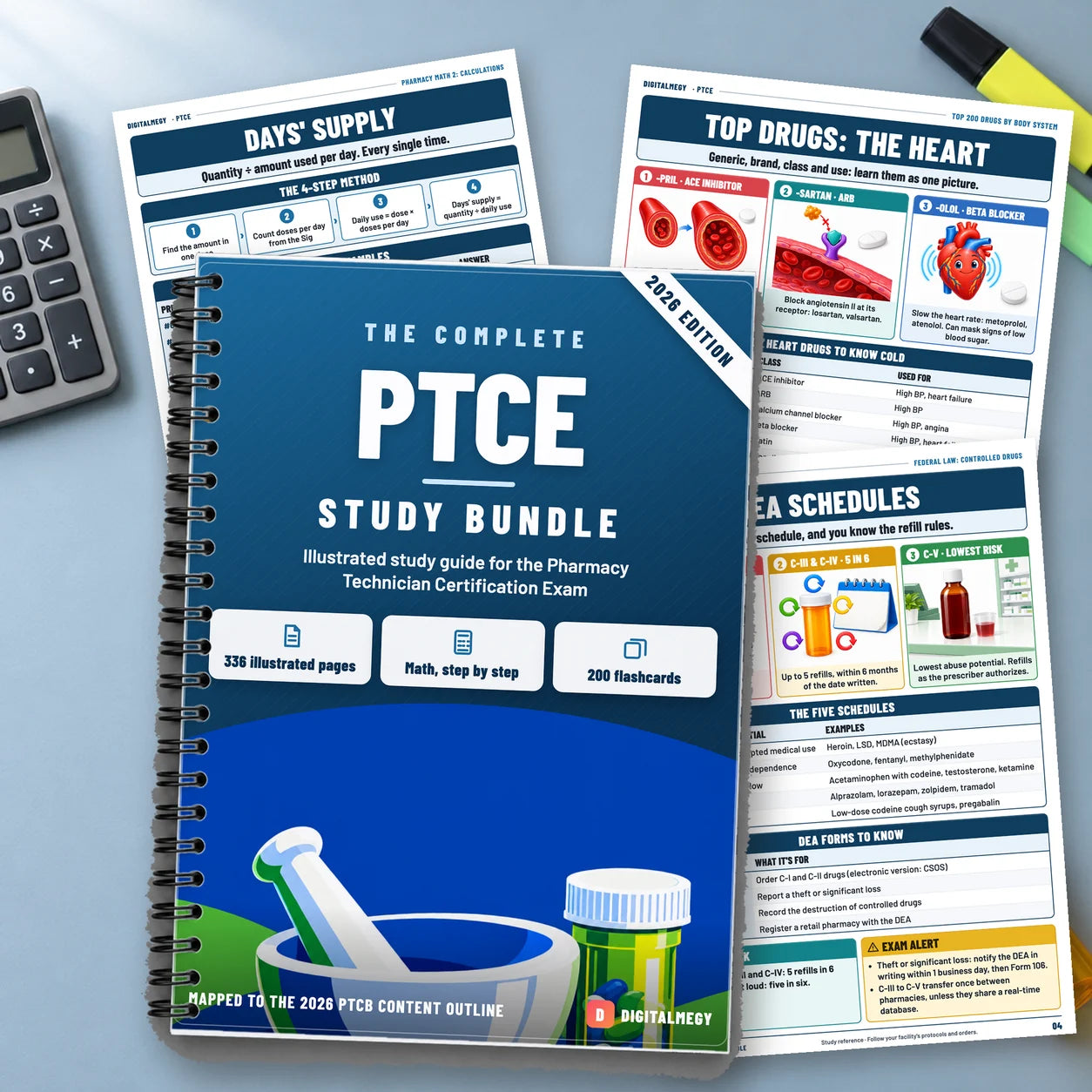
Brand and generic names, drug classes, DEA schedules and pharmacy math don't stick from a wall of text. 336 pages of numbered illustrations, comparison charts, mnemonics and memory tricks turn the PTCE into pictures you can read at a glance. Every chapter is mapped to the PTCB content outline, so you always know which part of the exam you're studying.
Not notes. A visual system.
Every spread uses the same five tools, so your brain always knows where to look, even after a long shift on your feet.
Whatever your schedule, you start today.
Make sense of the names
Brand and generic names, classes and stems drawn so you understand what each drug is for, not just how to type it. Use them at the counter now, and they're your PTCE review the day you book your date.
Ten minutes is enough
Every topic fits on a short page you can read on a break or after a shift. Plus the 4 quick-reference cards to keep handy: conversions & Sig codes, DEA schedules & forms, drug stems, and error-prone abbreviations.
Worked step by step
Two chapters, 64 pages, take days' supply, dilutions, alligation and IV flow rates one step at a time, with a quick check that the answer makes sense. No school-math memories required.
Know the drug. Know the rule. Get the order right.
The PTCE is 90 questions (80 scored, 10 unscored) in 1 hour 50 minutes, split across four areas: Medications (35%), Federal Requirements (18.75%), Patient Safety and Quality Assurance (23.75%) and Order Entry and Processing (22.5%). So every chapter in the bundle is mapped to one of those areas, and you always know which part of the exam you're studying.
Know the drug
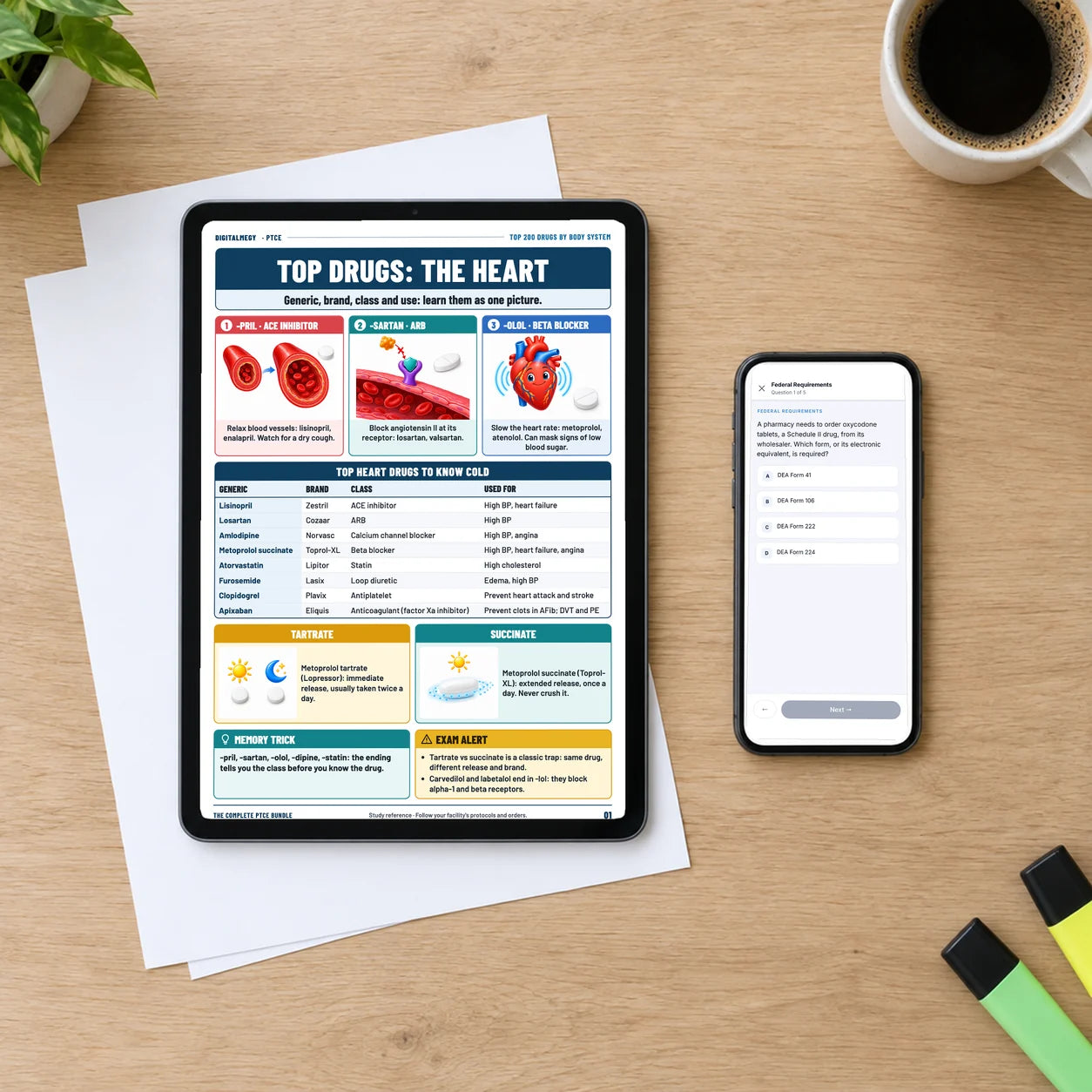
The top 200 drugs by body system, the stems that reveal the class, dosage forms, routes and storage. Drawn so generic, brand, class and use stick together as one picture.
Know the rule
DEA schedules and forms, ordering, theft and disposal, restricted products, high-alert and look-alike drugs, error-prone abbreviations, infection prevention. The comparison charts put the look-alikes side by side.
Get the order right
Reading the prescription, the Sig, NDC, lot and expiration, supplies, returns and the pharmacy math, worked from the order to the answer, one step at a time.
Every formula worked step by step.
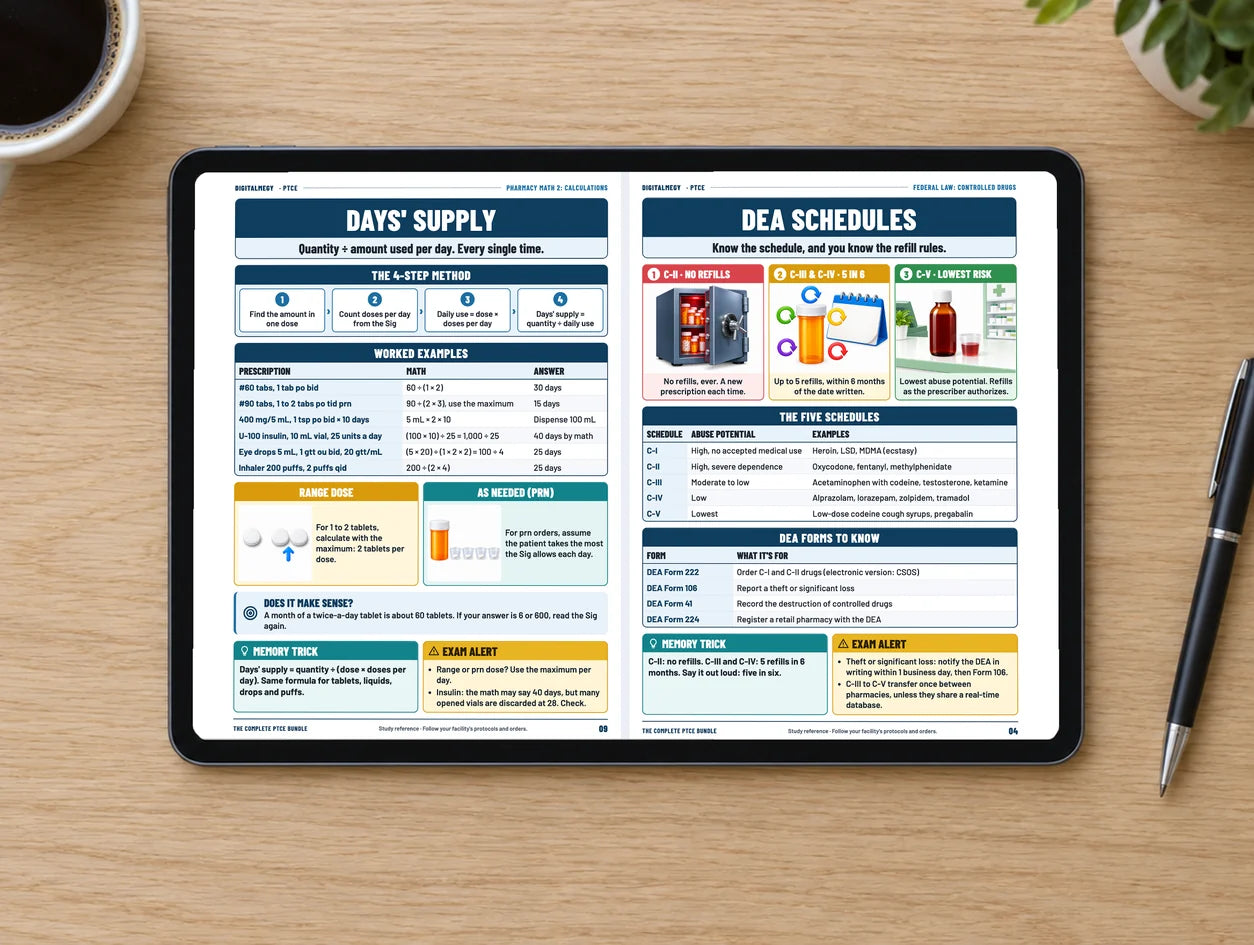
Days' supply, dose by weight, dilutions and drip rates look different on every prescription until you see they're the same few moves. Here each calculation is worked from the Sig to the answer, with a quick check that the number makes sense.
- Sig codes, Roman numerals and conversions on one page, so you can read the prescription before you do any math
- Days' supply as a 4-step method: dose, doses per day, daily use, quantity ÷ daily use
- Percent and ratio strengths, C1 × V1 = C2 × V2 dilutions, alligation and IV flow rates, each worked step by step
- A "does it make sense?" check on every answer
Know the drug by its ending.
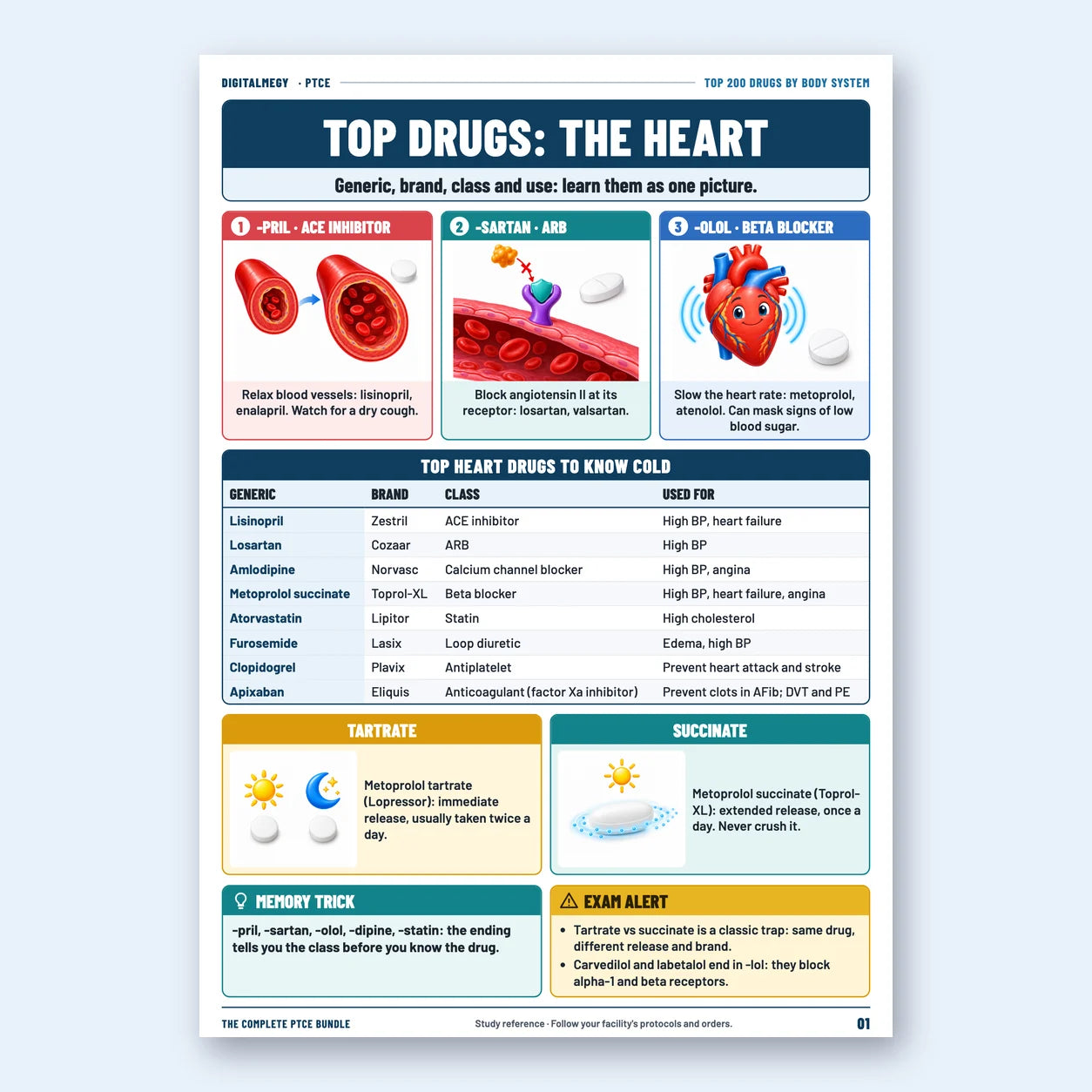
Hundreds of names, and nobody hands you a cheat sheet at the counter. Here the top 200 drugs are grouped by body system with generic, brand, class and use together, and the stems tell you the class before you know the drug.
- The top 200 drugs by body system: generic, brand, class and use in one table
- Stems like -pril, -sartan, -olol and -statin, so a new name stops being a stranger
- Look-alike traps side by side, like tartrate vs succinate
- Duplication, interactions, side effects and allergies: what to flag for the pharmacist, who makes the call
Know the schedule, know the rules.
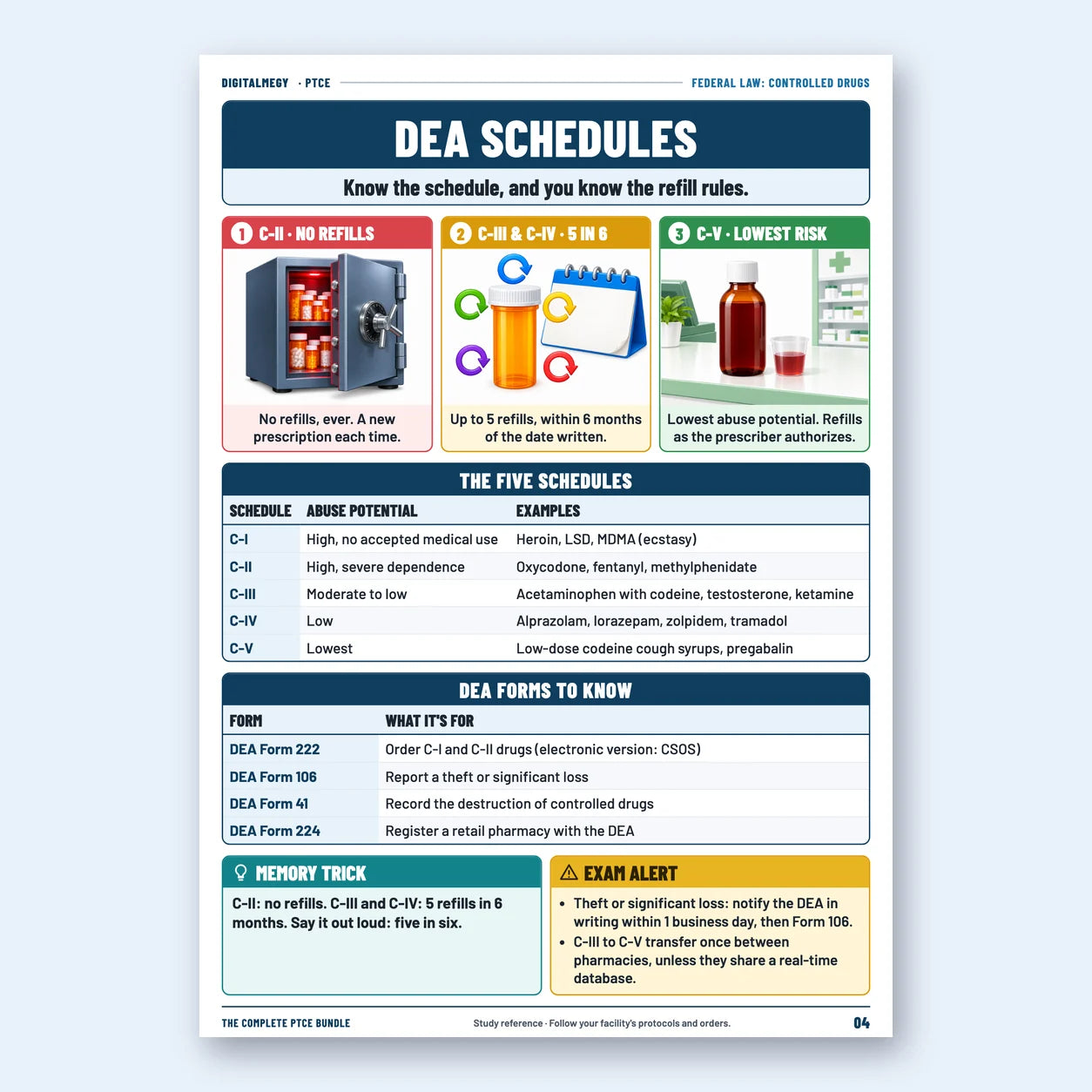
Refills, transfers, ordering forms, theft reports: the answer almost always starts with the DEA schedule. Here the five schedules, the DEA forms and the restricted-product rules sit on charts you can picture.
- DEA schedules C-I to C-V with examples, and the refill rules for each
- The DEA forms side by side: 222, 106, 41 and 224
- Controlled-substance prescriptions (new, refill, transfer), ordering, storage, theft and disposal
- Pseudoephedrine limits, REMS, FDA recall classes and DSCSA
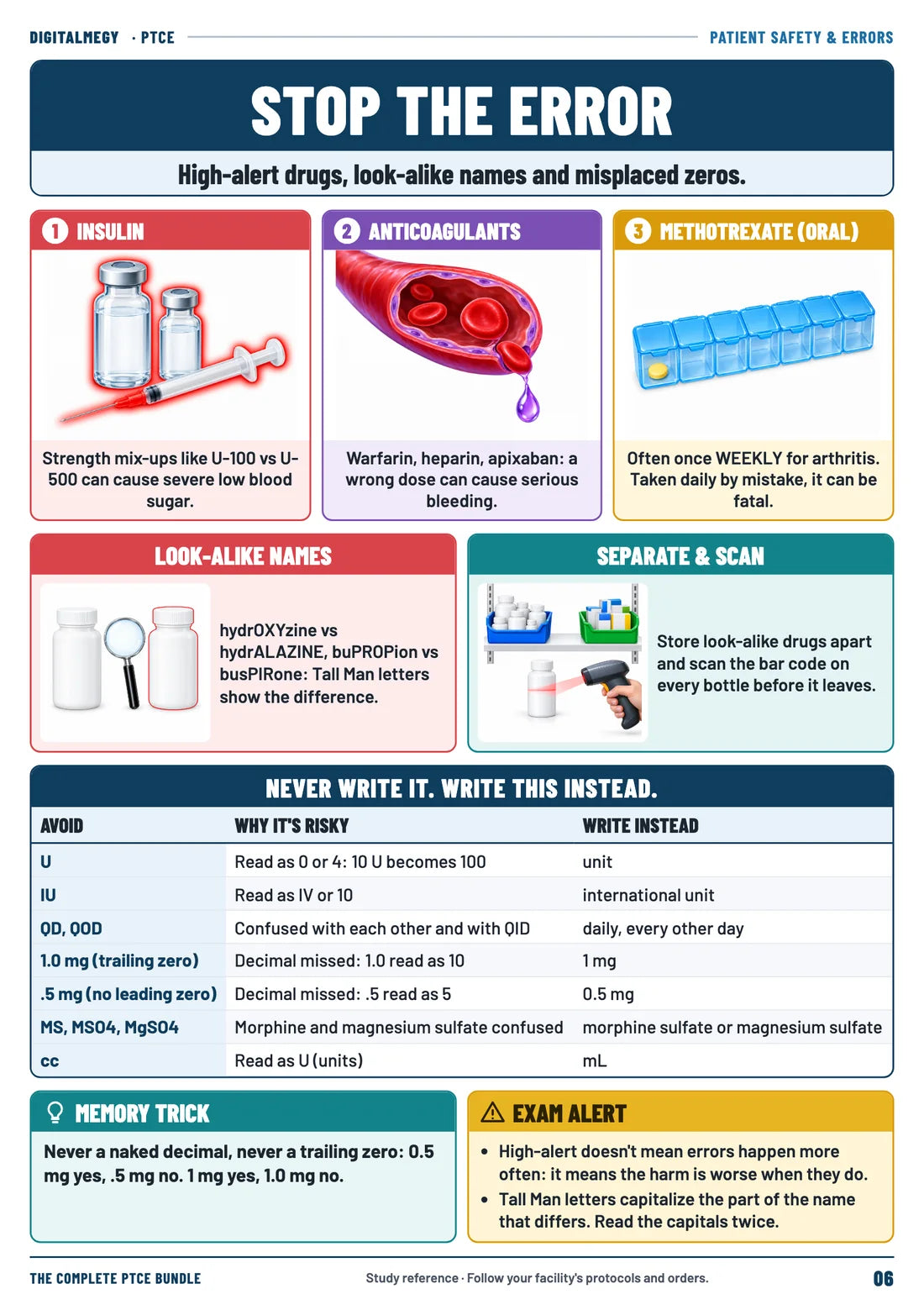
Stop the error before it leaves the counter.
High-alert drugs, look-alike names and a misplaced decimal are how errors happen. Here each one is drawn, together with the habit that catches it.
- High-alert drugs like insulin, anticoagulants and oral methotrexate: why a mix-up does so much harm
- Look-alike names with Tall Man letters, and how to store and scan them
- The error-prone abbreviations: never write them, write this instead
- Prescription errors, and when to stop and call the pharmacist
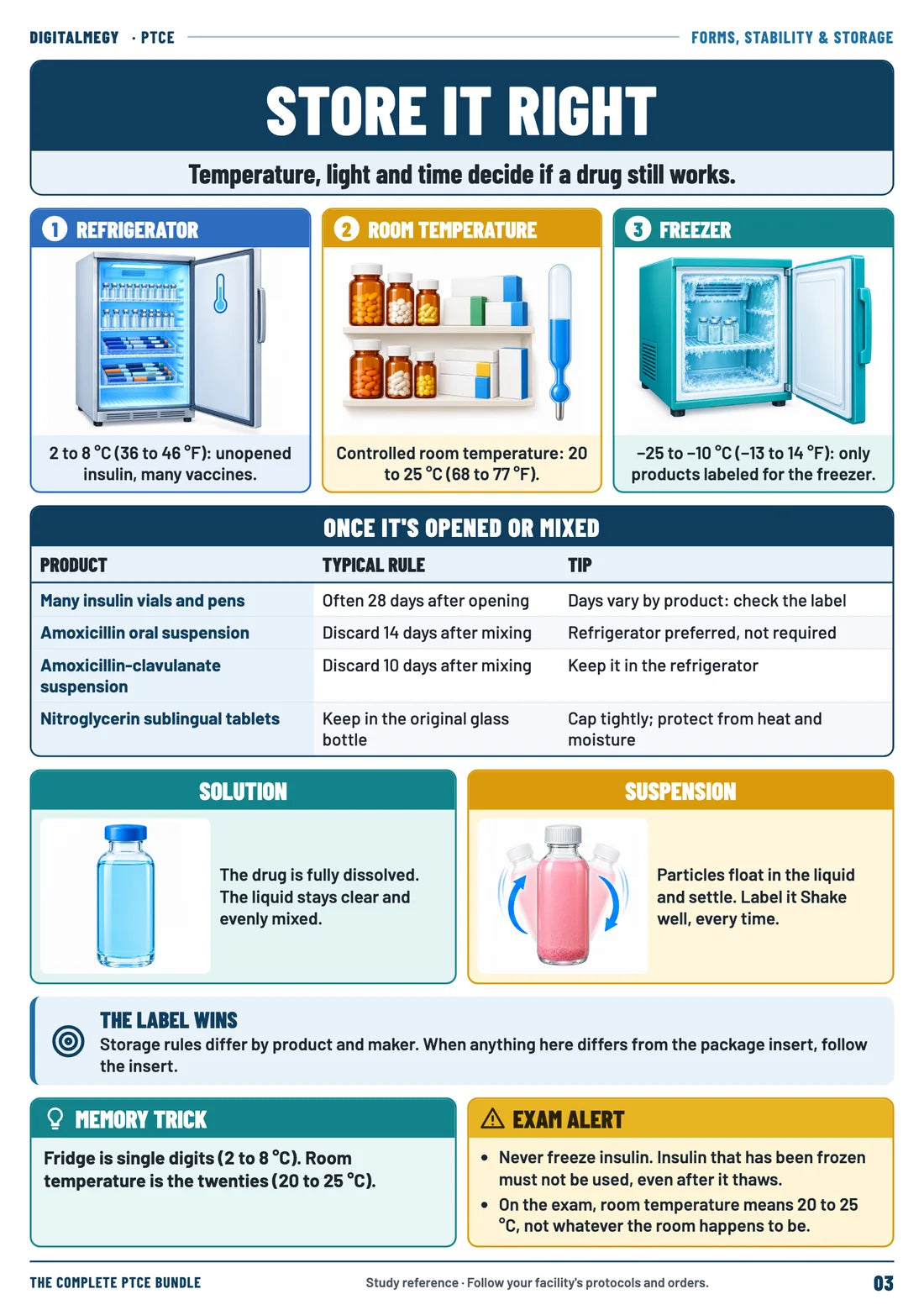
Store it right. Prep it clean.
Temperature, light and time decide if a drug still works, and clean technique decides if it's safe. Here the rules are drawn the way you'd see them on the shelf and at the counting tray.
- Refrigerator, room temperature and freezer ranges drawn side by side
- Solution vs suspension, and the discard dates for opened or mixed products
- Hand hygiene, PPE and cleaning the counting tray, including after penicillins or sulfa drugs
- MedWatch, VAERS, RCA and CQI in plain language
- "The label wins": when anything here differs from the package insert, follow the insert
The last weeks before the PTCE, on 20 pages.
The drugs, DEA schedules, conversions and abbreviations you need to have cold, condensed into cram sheets you can reread between shifts.
- Conversions, Sig codes and the 5-15-30 rule at a glance
- DEA schedules, forms and refill rules on one page
- Drug stems and error-prone abbreviations at a glance
- Every chapter linked to the four areas of the PTCE content outline

Your review book explains it. These pages show it.
The drawing, the color and the layout are the mnemonic: you remember the page, so you remember the answer.
- Mapped to the PTCE content outline, area by area
- Illustrations, charts and mnemonics on every topic
- Updated every year; ebook buyers get the new edition free
Inside the bundle.
The whole outline, in one bundle.
Full table of contents
On your iPad, on your phone, or printed at home.
Instant download, hyperlinked index
Works in GoodNotes, Notability and any PDF app. Full color, 8.5 × 11, prints cleanly at home. Free update every year.
200 flashcards and 4 quick-reference cards.
150 brand/generic pairs plus 50 on law, safety and math: the name on one side, the answer on the other. Print them, ring them, or swipe them in GoodNotes on your break. The quick-reference cards cover conversions & Sig codes, DEA schedules & forms, drug stems, and error-prone abbreviations.
- Printable PDF flashcards
- Digital version with hyperlinked index
- Quick-reference cards as a printable PDF, ready to laminate
Get 10 real pages, free.
The top heart drugs by class, the DEA schedules and forms, days' supply worked step by step, dilutions and alligation, the Sig codes and conversions, and the abbreviations you should never write. Study them after your next shift and decide with the pages in your hands.
How it stacks up.
| Feature | This bundle | Review book | Review course | Practice bank |
|---|---|---|---|---|
| Every topic built around a drawing | ✓ | Some figures | Mostly video & slides | ✗ |
| Pharmacy math worked step by step | ✓ | Varies | Varies | Question by question |
| Mnemonics and memory tricks in every chapter | ✓ | Varies | Varies | Varies |
| Practice questions | Pair with one | ✓ | ✓ | ✓ (timed) |
| iPad + print at home | ✓ | Print or ebook | Screen | Screen |
| Quick-reference cards to keep handy | ✓ | ✗ | Rarely | ✗ |
| Free ebook updates | ✓ | New edition $ | Varies | Varies |
| Price | $39.99 | Varies | Varies | PTCB's official bank: $65 |
Studying after your next shift, not next month.
Checkout
Secure checkout, no account to create. One price, everything included.
Open it anywhere
Your download link arrives by email. Open it in GoodNotes, Notability or any PDF app, or print the pages you need.
Start with the cram sheets
Print the cram sheets and the quick-reference cards, keep the rest on your iPad or phone, and study from page one tonight.
Everything, one price.
- 336 illustrated pages, 11 chapters, mapped to the PTCE content outline
- Every topic built the same way: drawn first, then the rule, the trap and the memory trick
- 60 pages of the top 200 drugs by body system
- 64 pages of pharmacy math, every formula worked step by step
- 200 printable & digital flashcards
- 4 quick-reference cards to keep handy
- PTCE cram sheets, 20 pages
- Free yearly update for the ebook
- Print any page at home, full color
The questions pharmacy technicians ask before buying
Will this be enough to pass the PTCE?
It covers the content the PTCE draws on: medications, federal requirements, patient safety and quality assurance, and order entry and processing, with the easy-to-miss distinctions flagged as exam alerts. But the PTCE is 90 questions (80 scored) in 1 hour 50 minutes, so you also need practice answering under time. Pair the bundle with a question bank: the pages help you remember, the questions teach you to apply.
Is this a subscription?
Yes. Today you pay $39.99 for the bundle and your first month of the DIGITALMEGY Club (monthly study-material updates, new resources and member-only discounts). After that, $39.99 every 30 days until you cancel. No minimum term. Cancel any time, at least 24 hours before your next charge, at support@digitalmegy.com or (801) 946-7564.
Does it include practice questions?
No, and we'd rather tell you up front. The bundle is the content: illustrated, organized and easy to review between shifts. For practice questions, pair it with a question bank. PTCB also sells official practice tools on ptcb.org. The two work together: pages to remember, questions to apply.
I already have a review book or a course. Do I need this?
Keep them. A course explains, a book goes deep, a question bank tests you. This is the part you reread: every topic on a page you can picture during the exam.
Can I sit the exam yet?
To sit the PTCE you need to complete a PTCB-recognized education or training program (or finish one within 60 days of applying) or have at least 500 hours of work experience as a pharmacy technician, among other requirements. The current rules on ptcb.org are the ones that count: check them before you book your date.
I work full time. When am I supposed to study?
That's who we built it for. Every topic fits on a short page you can get through in about ten minutes, on a break or after your shift. The quick-reference cards keep the conversions, Sig codes, schedules and abbreviations in front of you.
Math was never my thing. Can I keep up?
Yes, that's who the first two chapters are for. The 64 pages of pharmacy math start from the Sig and the conversions and work each calculation step by step, from days' supply to dilutions, alligation and IV flow rates, without assuming you remember school math.
I've worked in a pharmacy for years. Is this too basic?
The pages start from what you already see at the counter, then go to the distinctions the exam can test: tartrate vs succinate, a schedule that changes the refill rule, a limit counted in grams of base. Experienced technicians usually skim the familiar pages and spend their time on the exam alerts and the areas they don't handle every day.
My PTCE is in a few weeks. Is it too late?
No. Start with the cram sheets, use the exam alerts in each chapter to find your weak spots, and spend your time on the chapters behind the area that feels weakest. The 20 pages of cram sheets keep the essentials in one place for the last stretch.
I'm retaking the PTCE. Will this help?
Yes. Think about which of the four areas felt weakest, reopen the chapters behind it, drill practice questions on it, and finish with the cram sheets the week before. Check ptcb.org for the current retake rules.
Will it help with the ExCPT?
The bundle is written for the PTCE from PTCB. The ExCPT from NHA has its own outline and rules. The drugs, federal law, safety and math overlap, but check the ExCPT test plan on nhanow.com and use the chapters that match.
Will my employer pay for the exam?
It depends on your employer. Some reimburse the exam fee or study materials, some don't. Ask your manager or HR before you book the exam: they may cover part of the cost. Your order confirmation works as a receipt.
Can I use it at work?
The quick-reference cards and pages are made to keep handy while you study. But it's a study guide, not a reference for filling prescriptions: always follow the prescriber's order, the pharmacist, your pharmacy's policies and the product label.
Is it up to date?
Yes. This is the 2026 edition, mapped to the PTCE content outline that took effect on January 6, 2026. Some guides still use the older outline. We update this one every year, and ebook buyers get the new edition free.
Which apps does the ebook work with?
Any PDF app: GoodNotes, Notability, Apple Books, Adobe, Xodo. The index is hyperlinked so you can jump between chapters. You can also print any page.
Can I print it?
Yes. The PDF is 8.5 × 11, full color, and prints cleanly at home or at any print shop. A good plan is to print the cram sheets and the quick-reference cards, and keep the rest on your iPad or phone.
What if it isn't for me?
Email us within 30 days and we refund you. No questions, no forms.
Ready to walk into the PTCE knowing the drugs, the law and the math?
336 illustrated pages, 11 chapters, 200 flashcards, 4 quick-reference cards. Instant download. 30-day guarantee. Includes the DIGITALMEGY Club ($39.99 every 30 days, cancel anytime).
$39.99 · instant access